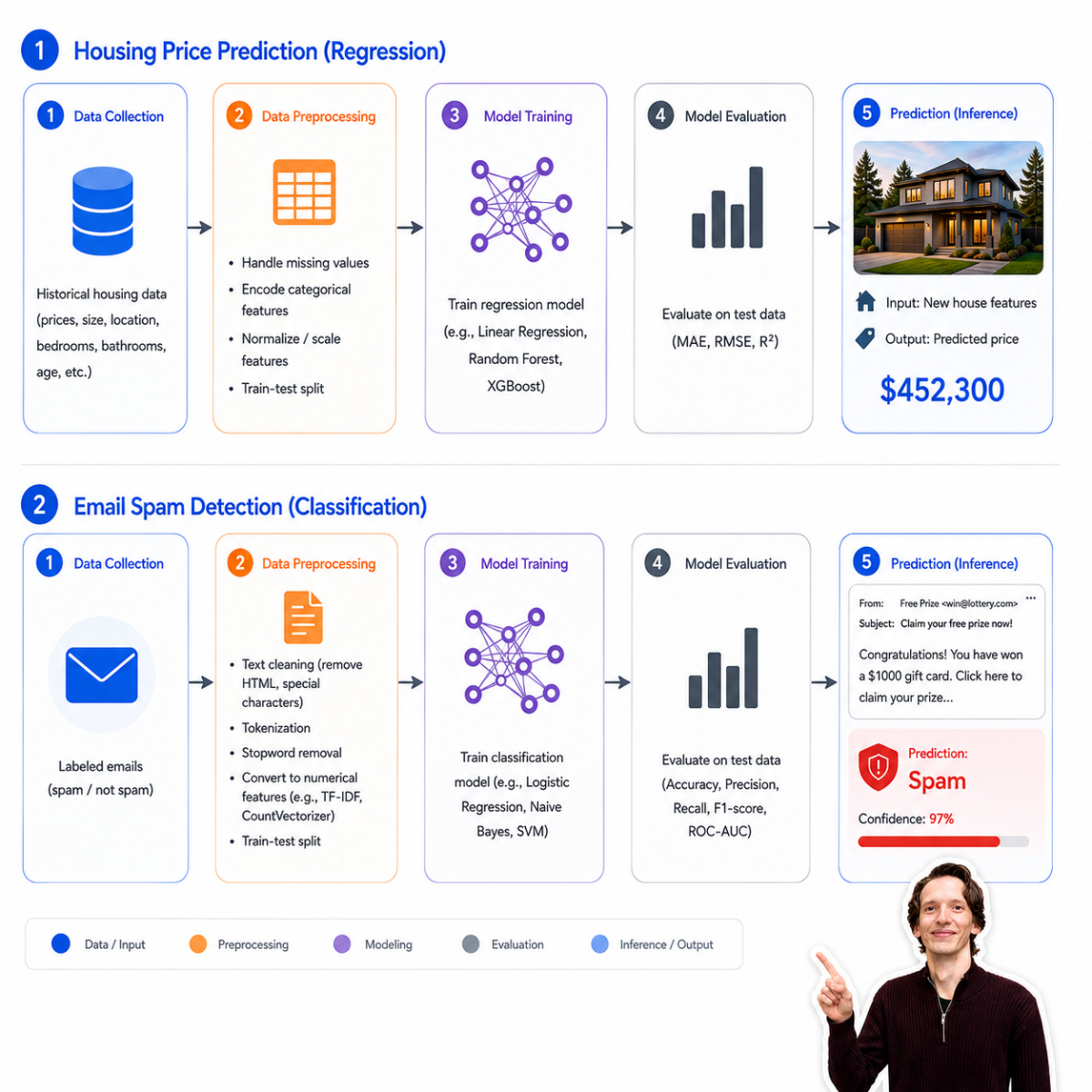
You want to learn machine learning. Great! Now you are staring at a screen full of courses, YouTube videos, Reddit threads, and bootcamp ads, and you have absolutely no idea where to begin.
After being over 10 years in the AI field, I have seen brilliant people give up on machine learning not because it was too hard, but because they started in the wrong place, hit a wall they did not expect, and concluded the whole thing was not for them.
This post is the guide I wish someone had handed me at the beginning. The honest, practical roadmap to go from complete beginner to someone who can actually build and deploy machine learning models. Not the theory (we covered that in our machine learning basics post). This is the how. The tools, the order, the timeline, and the mistakes to avoid.
And let me tell you one last thing: it is definitely not as hard as it seems. Trust me :)
Let's get into it.
The Machine Learning Learning Path at a Glance
Before we dive deep into each step, here is the entire roadmap visualised. Every step builds on the previous one, and skipping ahead is the number one reason beginners get stuck.
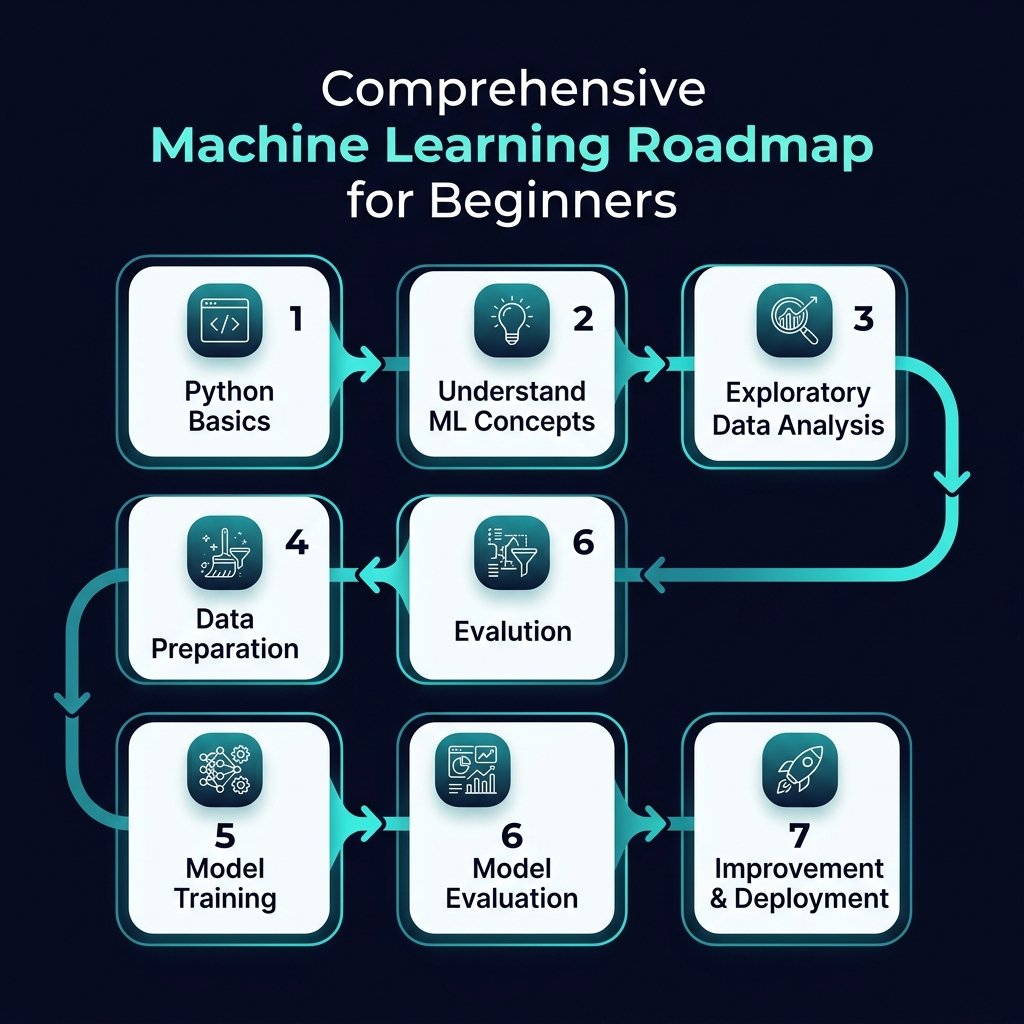
Now let us break each step down.
Step 1: Python First, But Not Too Much Python!
Before you touch a single machine learning concept, you need to be able to write basic Python. Not software-engineer-level Python. Just enough to load data, write a function, and run a script.
What you actually need:
- Variables and data types
- Loops and conditionals
- Functions
- Lists and dictionaries
- Importing libraries
That is it. A few weeks of consistent practice will get you there. Do not disappear into a six-month Python deep dive — that is procrastination dressed up as preparation. Ask your best friends (I mean Claude, Gemini, ChatGPT... They are amazing) for help, they really know how to code and teach coding.
Once you can write simple scripts without completely panicking, you are ready to start machine learning.
Step 2: Understand What Machine Learning Actually Is
Here is the simplest way to think about it: normally, when you write code, you write the rules. You tell the computer exactly what to do in every situation. Machine learning flips that around. Instead of writing the rules, you give the algorithm a pile of examples (historical data where you already know the outcome) and it figures out the rules itself.
A machine learning model is a pattern-finding machine. You feed it enough examples, it learns what those examples have in common, and then it uses that knowledge to make predictions on data it has never seen before.
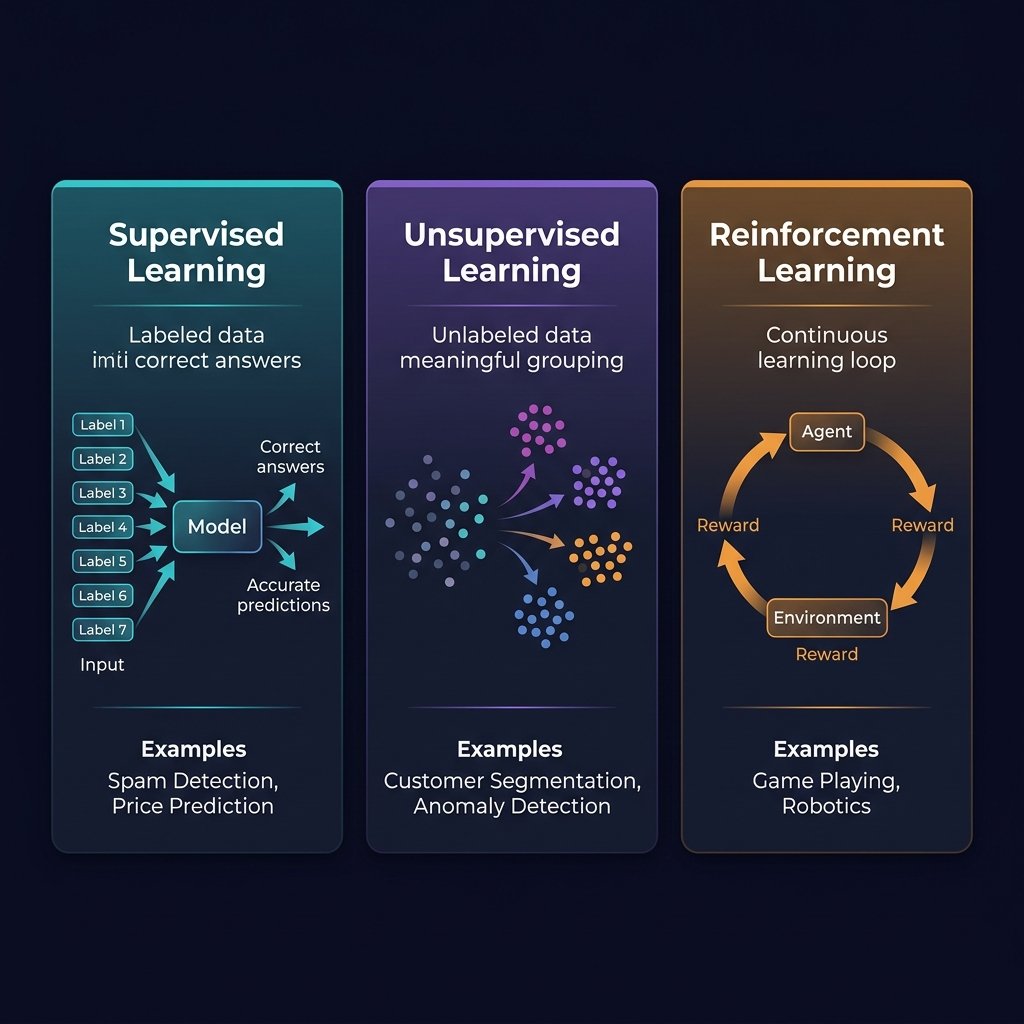
There are three main types of machine learning. Understanding these early will help everything else click:
| Type | How It Works | Example Use Cases |
|---|---|---|
| Supervised Learning | You give it labelled examples (input + correct answer) and it learns to predict the answer for new inputs | Spam detection, house price prediction, medical diagnosis |
| Unsupervised Learning | No labels — the algorithm finds hidden patterns and groupings in the data on its own | Customer segmentation, anomaly detection, recommendation systems |
| Reinforcement Learning | An agent learns by trial and error, receiving rewards for good actions and penalties for bad ones | Game playing (AlphaGo), robotics, trading bots |
As a beginner, you will spend 90% of your time on supervised learning. That is where you should start. If you want a deeper dive into these concepts, check out our machine learning basics: core concepts explained simply post.
Step 3: The Core Skills of Machine Learning
Pay attention! This is where most people get it wrong and get lost. However, it is not hard if you know the path. People think machine learning is about knowing a long list of algorithms. It is not. Others think they need a math background for it. That is simply not true. It is about mastering a set of core skills that every project requires, in roughly the same order, every single time.
Here is what that actually looks like.
Exploratory Data Analysis (EDA)
Before you build anything you need to understand what you are working with. As an example, you may want to predict who will pay future mortgages based on past data. At that point you should ask yourself: Where does the data come from? What do the columns actually mean? What is missing? What looks suspicious?
EDA is the skill that separates people who build models that work from people who build models that silently fail. It is also the step that is least taught and most skipped. Same as with Python, do not spend 6 months on learning EDA, spend a few weeks and move next.
Data Preparation
Real-world data is a mess. Missing values, inconsistent formats, outliers that make no sense, categorical variables that need to be converted into numbers. The prior step prepares you to understand all of it, on this step you will focus on how to prepare it for training.
Data preparation is where you spend most of your time on any real project. Learn to clean data well, and everything downstream becomes easier.
Model Training
This is the step everyone gets wrong. People think this is the big one. It is not. In practice, once your data is clean, training often takes a few lines of code and you are ready to go.
Here is a real example. This is literally all it takes to train a machine learning model with Scikit-learn:
# Load a dataset
from sklearn.datasets import load_iris
from sklearn.model_selection import train_test_split
from sklearn.ensemble import RandomForestClassifier

# Load data and split into training and testing sets
X, y = load_iris(return_X_y=True)
X_train, X_test, y_train, y_test = train_test_split(X, y, test_size=0.2)

# Train the model — yes, it's this simple
model = RandomForestClassifier()
model.fit(X_train, y_train)

# Check the accuracy
accuracy = model.score(X_test, y_test)
print(f"Accuracy: {accuracy:.2%}")  # Typically 95%+
That is it. The two previous steps (EDA and data preparation) are where the magic of machine learning occurs — having and preparing good data. However, I recommend understanding about the different models so that you know when to use one or another. Hearing a short class on how they work will highly benefit you.
Model Evaluation
This is an important one. It is not hard, but can be slightly confusing, and many beginners make mistakes without realising.
Accuracy alone is a terrible metric for most projects. Learn precision, recall, F1-score, and ROC-AUC. Understand the difference between overfitting (your model memorised the training data and fails on anything new) and underfitting (your model is too simple to capture the real patterns). Know the difference between your training set, validation set, and test set, and never, ever mix them up.
Model Improvement (optional)
Once you have a baseline model, you can make it better. This means tuning hyperparameters, trying different algorithms, and engineering better features from your raw data. This is where craft comes in and where the interesting problem-solving happens.
Deployment (optional)
A model sitting on your laptop is not useful. Learn to put it somewhere that actually does something — an API, a simple web app, a scheduled job. You do not need to become a software engineer to do this, but you need to know the basics.
Step 4: The Machine Learning Algorithms Worth Knowing
Once you understand the core skills, algorithms start to make sense. Now you know what problem they are solving. You do not need to memorise fifty of them. You need to understand a core set deeply.
| Algorithm | Type | Best For | Priority |
|---|---|---|---|
| Linear Regression | Supervised | Predicting continuous numbers (price, temperature) | 🟢 Learn first |
| Logistic Regression | Supervised | Binary classification (spam/not spam, churn/retain) | 🟢 Learn first |
| K-Nearest Neighbours | Supervised | Intuitive classification by similarity | 🟢 Learn first |
| Decision Trees | Supervised | Interpretable decisions, visual debugging | 🟢 Learn first |
| Random Forests | Supervised | Reliable general-purpose model, hard to beat | 🟡 Learn second |
| K-Means Clustering | Unsupervised | Grouping data into clusters without labels | 🟡 Learn second |
| SVM | Supervised | Smaller datasets, high-dimensional data like text | 🟡 Learn second |
| XGBoost / LightGBM | Supervised | Production tabular data, Kaggle competitions | 🔵 Learn third |
You do not need to implement these from scratch. What you need is to understand: why does this algorithm work? When should I use it? What does it assume about the data?
Step 5: The Libraries You Will Actually Use
Python for machine learning means a short list of libraries that you will use over and over again. Here is what each one does and when you will need it:
| Library | Purpose | When You Need It |
|---|---|---|
| NumPy | Numerical computing — arrays, matrix operations | Always. It is under the hood of everything |
| Pandas | Data manipulation — load CSVs, clean, merge, explore | Every single project, from day one |
| Matplotlib / Seaborn | Data visualisation — charts, distributions, outliers | During EDA and when presenting results |
| Scikit-learn | The gold standard ML library — every classical algorithm | Training, evaluation, preprocessing — your main tool |
| XGBoost / LightGBM | Advanced gradient boosting — industry workhorses | When you need top performance on tabular data |
Do not chase every new library. Master these first. They will carry you through 90% of real-world machine learning projects.
Step 6: Build Things That Are Slightly Uncomfortable
Reading is not learning machine learning. Building is learning machine learning.
After each concept, build something. It does not need to be impressive — it needs to be real. Some ideas:
- Predict housing prices with linear regression on a public dataset
- Build a spam classifier with logistic regression on email data
- Predict customer churn with a Random Forest
- Segment customers using K-Means clustering on e-commerce data
- Classify handwritten digits using a simple neural network
Go to Kaggle. Find a beginner competition. Download the data. Make a terrible first submission. Then make a slightly less terrible second one. That process teaches you more than any course.
The discomfort of working with messy, real data and not knowing exactly what to do is not a sign that you are doing something wrong. It is the actual learning.
Common Mistakes That Kill Your Progress
After years of teaching and mentoring people learning ML, I see the same mistakes over and over. Here is what to avoid:
| Mistake | Why It Hurts | What to Do Instead |
|---|---|---|
| Spending 6 months on Python before touching ML | Procrastination disguised as preparation | Learn Python basics in 3-4 weeks, then start ML |
| Jumping between 10 courses simultaneously | You never go deep enough on anything | Pick ONE resource and finish it completely |
| Skipping data preparation and EDA | Your models will silently fail on real data | Spend more time on data than on algorithms |
| Only using accuracy as a metric | Misleading on imbalanced datasets | Learn precision, recall, F1-score, and ROC-AUC |
| Trying to learn math before building anything | You lose motivation without seeing results | Build first, learn math when curiosity demands it |
| Never deploying a model | You miss the production reality that employers value | Deploy at least one model as an API or web app |
On Math: Stop Worrying About It
Yes, machine learning has mathematical foundations. Linear algebra, probability, calculus, statistics. They are all in there.
Here is the truth: you do not need to master any of that to start. Most of that is for people who will create the algorithms of the future, but not for building AI solutions today. You need enough statistics to understand what a mean and variance are. That is genuinely it.
Now, as you go deeper and start wondering why certain algorithms behave the way they do, you will naturally find yourself reading about the math behind them, but no need to master it. That is when it clicks, because you have context. Learning math in isolation, before you have built anything, is like studying the grammar of a language you have never spoken.
Pick up the math as you need it. Not before. If you want the full breakdown, check out our guide on mathematics for machine learning: what you actually need.
A Realistic Timeline to Learn Machine Learning from Scratch
For someone starting from scratch and putting in consistent time (a few focused hours per week):
| Phase | Duration | Focus | Deliverable |
|---|---|---|---|
| Phase 1 | Weeks 1–4 | Python basics — get comfortable with the language | Can write scripts, use loops, import libraries |
| Phase 2 | Months 2–3 | Core ML: EDA, data prep, training, evaluation, main algorithms, Scikit-learn | 2-3 small completed projects |
| Phase 3 | Months 4–5 | Real-world projects: Kaggle datasets, messy data, deployment | 1 Kaggle submission, 1 deployed model |
| Phase 4 | Month 6+ | Advanced: gradient boosting, feature engineering, model evaluation at depth | A solid GitHub portfolio |
If you go full-time, compress everything. Consistency matters far more than intensity. Someone who builds one small thing per week for six months will outperform someone who binge-studies for two weeks and stops.
Where to Go After Machine Learning
Once you are solid on classical machine learning, a whole world of specialisations opens up. Here is how the landscape connects:
- Deep learning — neural networks for images, text, audio. Read our deep learning for beginners guide
- Natural language processing (NLP) — making computers understand text. Start with our NLP explainer for beginners, explore core tasks like sentiment analysis and named entity recognition, or check the NLP techniques roadmap
- Computer vision — making computers see. Check our computer vision beginner's guide or the deep learning for computer vision roadmap
- MLOps and deployment — putting models into production at scale
All of these build directly on the machine learning foundations covered in this roadmap. Master the basics, and every specialisation becomes dramatically easier.
The Summary
Start with Python basics. Learn what machine learning actually is: pattern recognition from data, not magic. Then master the core skills in order: understand your data, prepare it, train a model, evaluate it properly, improve it, and deploy it. Learn the key algorithms well rather than every algorithm superficially. Build real things with real data. Pick up math as you need it, not before.
That is how you learn machine learning from scratch. It is not as hard as the internet makes it seem. It just requires a clear path and the discipline to follow it.
At Fondra Labs, we are building the step-by-step resources to walk you through exactly this journey. Stay tuned.
Frequently Asked Questions

Javier Aguirre
Teaching AI from production reality, not hype.
Build your AI Foundations
Get the free checklist that production engineers use to avoid these common RAG pitfalls.
Get the Free Guide