You've used it today. Probably without noticing.
Every time your phone autocompletes a sentence, every time Gmail moves a suspicious email to spam, every time you ask Google a question and it actually understands what you meant: that's natural language processing at work.
And yet most people couldn't explain what it actually is.
This post fixes that. By the end, you'll have a clear, honest understanding of what NLP is, how it works, where it shows up in the real world, and how to get started with it. No jargon. No unnecessary complexity. Just the real thing, explained so it actually makes sense.
What Is NLP?
Natural language processing (NLP) is the field of AI that teaches computers to understand human language.
That's it at its core. But let's unpack why that's harder than it sounds.
Computers are designed for precision. They're comfortable with numbers, rules, and structured data. Tell a computer that 2 + 2 = 4 and it will never be confused. But human language is the opposite of precise. It's full of ambiguity, context, and meaning that shifts depending on who's speaking, how they're saying it, and what came before.
Take this sentence: "I saw the man with the telescope."

Did you use a telescope to see the man? Or did you see a man who was holding a telescope? Both are valid readings of the exact same sentence. A human picks the right one instantly using context. A computer has to be taught how to do that.
Or take the word "sick." Depending on who says it and where, it can mean ill, disgusting, or (if you're under 30) genuinely impressive.
NLP is the field dedicated to teaching computers to navigate all of that.
Why Does This Matter?
Think about how much of the world runs on language.
Emails. Contracts. Medical records. Customer reviews. News articles. Social media. Search queries. Support tickets. Code documentation.
Most of the information that matters to businesses, governments, hospitals, and individuals exists as unstructured text. Nobody sat down and put it into tidy rows and columns. It's just words.
For decades, this information was largely unprocessable at scale. You couldn't automatically read a million customer reviews to understand what people loved or hated about your product. You couldn't scan thousands of legal contracts to flag the risky ones. You couldn't build a system that actually understood what a user was asking for.
NLP changed that. It turned language into something computers can work with.
How Does NLP Work?
Here's the honest answer: NLP works by converting text into numbers, finding patterns in those numbers, and using those patterns to make predictions or generate new text.
Let's break that down into something concrete.
Step 1: Breaking Text Apart
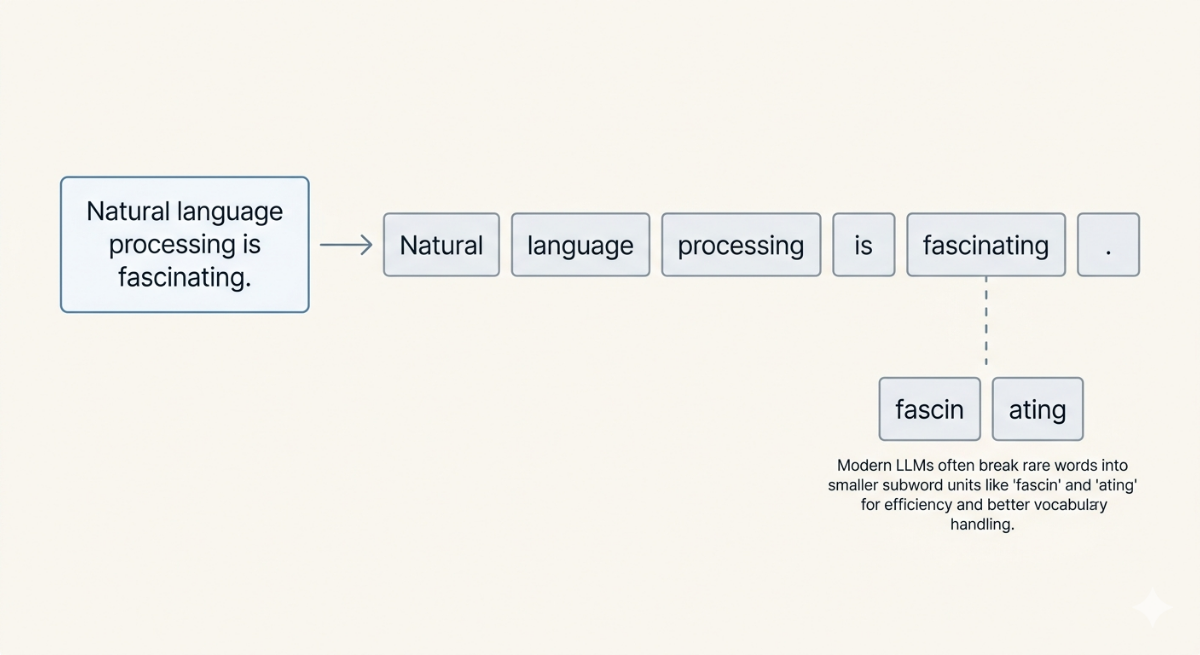
Before a computer can understand a sentence, it needs to split it into manageable pieces. This is called tokenization.
The sentence "NLP is fascinating" becomes something like: `["NLP", "is", "fascinating"]`. These pieces (tokens) are the units the model actually works with.
Simple enough. But tokenization gets interesting fast. Modern AI models don't always split on words. They often split on parts of words. The word "fascinating" might become `["fascin", "ating"]`. This is called subword tokenization, and it's one of the reasons modern language models can handle words they've never seen before.
Step 2: Turning Words into Numbers
Computers can't process words directly. Everything needs to become a number.
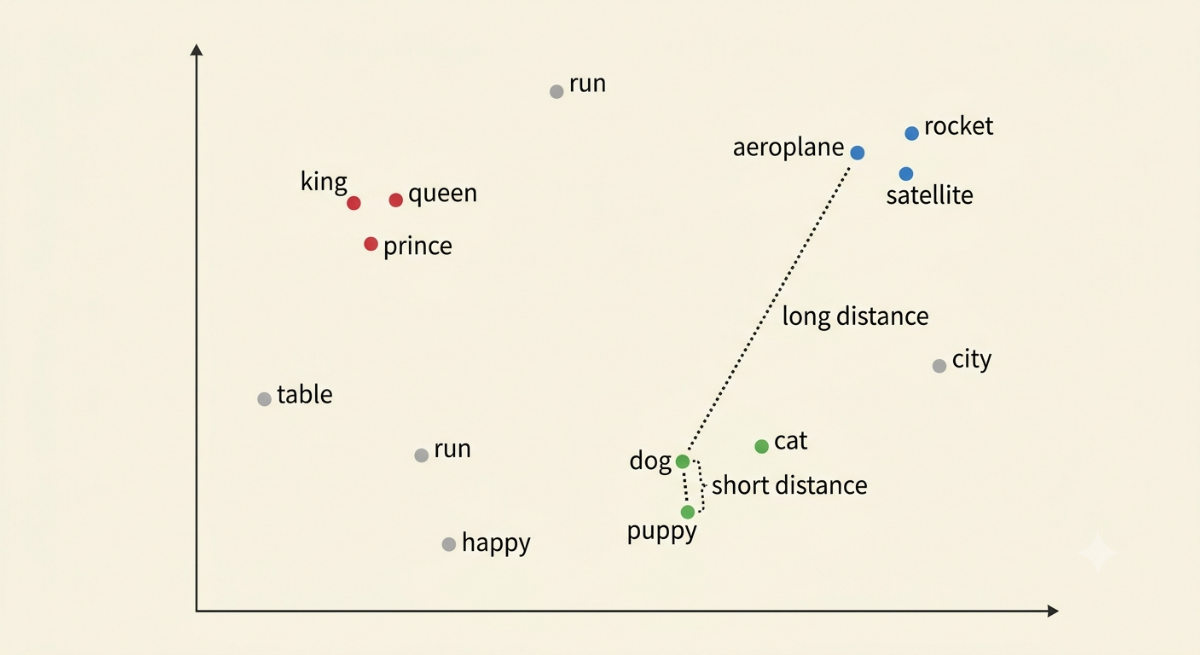
The clever solution NLP researchers found is called word embeddings. Each word gets converted into a list of numbers (a vector) that captures its meaning. Words with similar meanings end up with similar vectors. "Dog" and "puppy" are close together. "Dog" and "aeroplane" are far apart.
This is how meaning gets encoded into something a computer can actually compute with.
Step 3: Finding Patterns
Once text is in numerical form, machine learning models can find patterns in it.
Think of it like this: if you show a model millions of sentences and tell it which ones are positive and which are negative, it learns to recognize the patterns that signal each. It starts noticing that words like "love," "amazing," and "perfect" tend to appear in positive sentences. Words like "terrible," "waste," and "broken" tend to appear in negative ones.
That's sentiment analysis, one of the most widely used NLP tasks, and it works through the same basic loop: show the model many examples, let it find the patterns, use those patterns to make predictions on new text.
The Transformer: Why Modern NLP Is So Powerful
For a long time, NLP models had a fundamental limitation: they processed language one word at a time, left to right. They'd often "forget" what was said at the start of a long sentence by the time they reached the end.
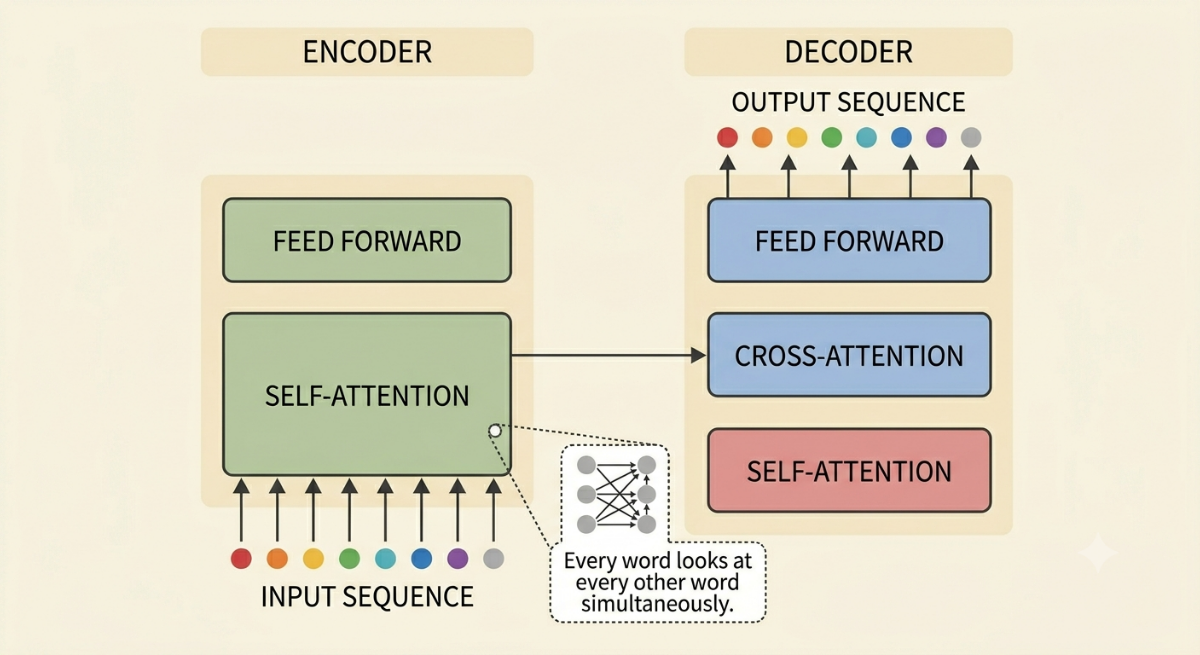
In 2017, a team at Google introduced a new architecture called the Transformer. The key idea was simple but powerful: instead of reading words one by one, process all of them at once, and let every word pay attention to every other word simultaneously.
This meant the model could understand that the word "it" at the end of a paragraph referred to something mentioned at the beginning. It could track relationships across long stretches of text without losing track.
"Attention is all you need."
— Vaswani et al., Google Brain, 2017
Every major AI language system you've heard of (ChatGPT, Claude, Gemini, BERT) is built on the Transformer. It was the breakthrough that made modern NLP possible.
NLP in Artificial Intelligence: Where It Fits
If you're trying to understand how NLP relates to AI more broadly, here's a simple way to think about it.
Artificial intelligence is the big umbrella. It's the general goal of making machines that can do things that normally require human intelligence.
Under that umbrella, there are different areas depending on what type of intelligence you're trying to replicate:
- Computer Vision: understanding images and video (what's in this photo?)
- Speech Recognition: understanding spoken audio (what did that person just say?)
- Natural Language Processing: understanding and generating text (what does this sentence mean?)
NLP is the branch of AI focused specifically on language. And increasingly, these areas are merging. Modern AI systems handle text, images, and audio together. But NLP remains the backbone. Even in multimodal systems, language is how instructions are given and how outputs are delivered.
NLP and Machine Learning: What's the Relationship?
This trips a lot of beginners up, so let's clear it up once and for all.
Think of it as nested circles:
- Artificial Intelligence is the outermost circle: the broad goal of intelligent machines
- Machine Learning sits inside AI: it's the approach of teaching machines by showing them data rather than writing explicit rules
- Deep Learning sits inside ML: it's machine learning using large neural networks
- NLP is an application: it's ML and deep learning applied to the specific problem of language
So NLP isn't a competitor to machine learning or deep learning. It uses them. It's what you get when you take those tools and point them at language.
NLP Examples: Where You've Already Seen It
The best way to make NLP concrete is to look at where you already use it every day.
Spam filters read your incoming email and decide whether it's legitimate or junk. They learned to do this from millions of examples of spam and non-spam emails. Now they make that judgment in milliseconds, invisibly, on every email you receive.
Search engines don't just match keywords anymore. When you type "best way to cook chicken without drying it out," Google doesn't look for pages containing those exact words. It understands the intent (you want a moist chicken) and surfaces pages that address that, even if they use completely different words.
Virtual assistants (Siri, Alexa, Google Assistant) listen to your voice, convert it to text, figure out what you're asking for, retrieve the answer, and speak it back to you. NLP is running at every single step of that process.
Machine translation tools like Google Translate take text in one language and produce text in another, handling grammar, idioms, and context that would have seemed like science fiction twenty years ago.
Autocomplete on your phone has learned from how you type. It predicts what you're about to say based on patterns it has observed across millions of conversations.
ChatGPT, Claude, Gemini (the AI assistants you may already use) are the most advanced NLP systems in existence. They can write, explain, summarise, translate, code, and reason in natural language.
NLP Applications Across Industries
NLP isn't just for consumer apps. It's quietly transforming how whole industries operate.
Healthcare: Doctors write clinical notes in natural language, unstructured text that's hard to search or analyse. NLP systems can read these notes and extract structured information: what diagnosis was made, what medication was prescribed, what symptoms were mentioned. This makes patient records usable in ways they previously weren't.
Finance: Analysts use NLP to monitor news and earnings call transcripts for signals. When a CEO says "we're cautiously optimistic" versus "we're very confident," the difference matters. NLP systems can track these signals across thousands of documents simultaneously.
Legal: Lawyers spend enormous amounts of time reading contracts. NLP tools can scan a contract, flag unusual clauses, compare it against standard templates, and summarise the key terms. Tasks that previously took hours now take minutes.
Customer service: When you submit a support ticket or chat with a bot, NLP is classifying your request, routing it to the right team, and often generating the first response. The better the NLP, the less you notice you're not talking to a human.
The common thread: wherever there's unstructured text that matters, NLP creates value.
Getting Started with NLP in Python
If you want to go beyond understanding NLP and actually start building with it, Python is where you start. It's the language the entire NLP community uses, and the tools are excellent.
Three libraries worth knowing about:
NLTK (Natural Language Toolkit) is the classic beginner library. It's great for learning the basics: tokenization, stemming, simple text analysis. Not what you'd use in production, but a solid starting point for understanding concepts.
spaCy is the professional-grade library. Fast, reliable, and built for real-world use. If you're building something that needs to run in production, spaCy is usually where you land.
Hugging Face Transformers is where modern NLP lives. It gives you access to thousands of pretrained models (including the same architectures behind ChatGPT and BERT) with just a few lines of code.
Here's what that looks like in practice:
from transformers import pipeline

classifier = pipeline("sentiment-analysis")
result = classifier("I absolutely loved this product.")
print(result)
# [{'label': 'POSITIVE', 'score': 0.9998}]
Four lines of code. State-of-the-art sentiment analysis. That's the power of the current ecosystem.
A sensible learning path:
- Start with NLTK to get comfortable with the basics
- Move to spaCy when you want to build something real
- Learn the concepts (tokens, embeddings, attention) before jumping to Hugging Face
- Use Hugging Face to fine-tune pretrained models on your own data
The concepts are more important than the tools. Tools change. The ideas behind them don't.
What Comes Next
You now understand what NLP is, why it matters, how it works at a high level, and where it shows up in the world.
This is the foundation. The rest of this series builds on it, one concept at a time:
- Tokenization: how text gets split into the pieces models actually process, including the subword methods that power every modern LLM
- Word Embeddings: how words become numbers that carry meaning, from Word2Vec to BERT
- Named Entity Recognition: teaching models to find people, places, and organisations in text
- Sentiment Analysis: detecting opinion and emotion at scale
- Semantic Search & RAG: how NLP powers modern search and AI assistants
Each post goes deeper on one piece of the picture. If you follow the series in order, you'll build a solid, practical understanding of NLP from the ground up, the kind that actually helps when you sit down to build something.
Frequently Asked Questions

Javier Aguirre
Teaching AI from production reality, not hype.
Build your AI Foundations
Get the free checklist that production engineers use to avoid these common RAG pitfalls.
Get the Free Guide